One Morning You Wake Up in Çatalhöyük

One Morning You Wake Up in Çatalhöyük
You are inside a single-room house made of mudbrick. This house has no windows. On the side, there is only a door opening to a small storage area. In the middle of the roof made of reeds, there is an opening large enough for a person to pass through. A handmade wooden ladder is placed at this opening. The light filtering through the gap in the roof illuminates the surrounding walls. You notice the drawings on the walls. As you get up from where you lay to try and distinguish the details of these drawings, your back hurts a little. Çatalhöyük does not have the soft beds you are used to. You realize you woke up on a raised platform.
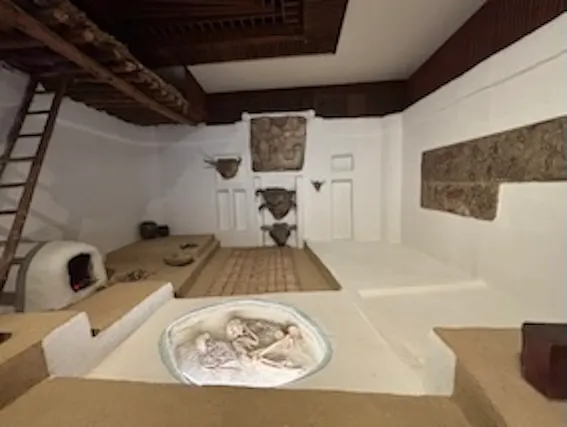
When you stand up and approach the walls, you see the paintings more clearly. Drawings made in yellow, black, and red tones on a light background… Hunting scenes, hands, various motifs. These images remind you of rug motifs used today. In some parts of the house, bull heads covered with clay catch your attention. While thinking “Where am I?”, your eyes get caught on the wooden ladder next to the smoking hearth and the opening above. When you climb the ladder and go outside, your astonishment increases.
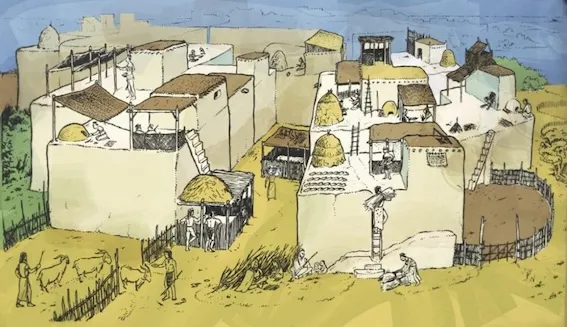
There are many other houses adjacent to the house you woke up in. There are no streets or alleys here. People reach each other through openings on the roofs. Daily life flows on the rooftops of the houses. While wandering in Çatalhöyük, you notice that everyone is busy with a different task. A group of people is harvesting in the agricultural areas around the houses. Some have just returned from the hunt; they are preparing their prey to eat with obsidian stones. Some are cooking their food on the hearth, while others are worshipping silently in areas that you think are temples due to their structure different from the others. A crowd catches your attention. When you approach, you see a homeowner burying a relative they lost in a fetal position inside their house. Just like under a platform where you woke up in the morning… The traces on the platform show that this place has been opened before. The people of Çatalhöyük bury their dead inside their houses as per their beliefs.
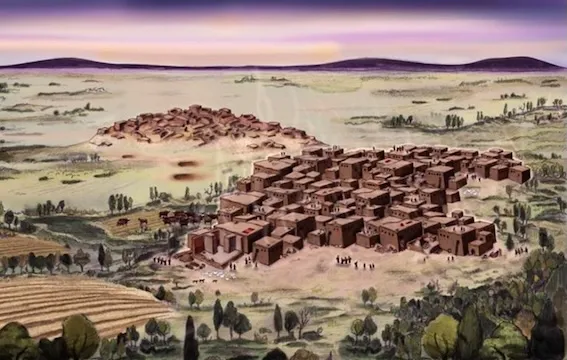
This tradition seems quite different to you. In the period you live in, people bury their lost relatives in separate cemeteries and visit them from time to time. However, in Çatalhöyük, the dead are right beside the living… As you continue to wander on the roofs, you realize that this settlement fascinates you. Çatalhöyük, whose first settlement traces date back to 7000 BC, was established in two separate areas as east and west. You see this clearly in the bird’s-eye view plan drawn on one of the walls. The East Mound is older; it was abandoned over time. The West Mound was built in a later period. The plans of the buildings are almost identical. This situation suggests that there is no distinct hierarchy in the settlement. Everyone is equal to each other. This awareness surprises you.
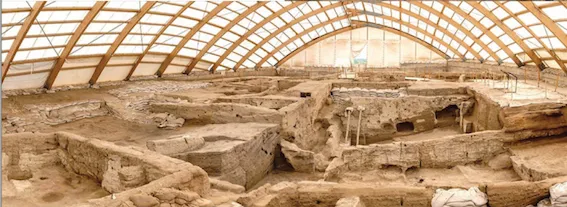
You inhale the air of 7000 BC and close your eyes. When you open your eyes, you are in the present day. You are on any floor of a multi-story building, in a house with plenty of windows facing the street. Below, there are tall buildings, heavy traffic, and a movement that never stops. Hierarchy is everywhere in this period. People bury their dead in areas far from themselves. Moreover, it cannot be said that the living want to be close to each other either.
Our next journey will be to Göbeklitepe. Close your eyes and get ready for a new historical journey. This time you will open your eyes in 10,000 BC.
📌 Watch the video version of this article on our YouTube channel
🔹 Editorial Note
• This article is part of a series at Pinatolia that conveys architectural knowledge through a fictional narrative.
🔹 References
• Çatalhöyük Research Project (UNESCO World Heritage Site).
• http://www.catalhoyuk.com/tr
🔹 Image Sources
• http://www.catalhoyuk.com/tr
• https://muze.gov.tr/muze-detay?SectionId=KCO01&DistId=MRK
🔹 Copyright Note
• The content of this article belongs to the author. It cannot be reproduced or used for commercial purposes without the author’s prior written permission.